Yellow Lines, Tight Corners and a Van Full of Amps: Manchester’s Street-Level Gig Rules
Photo: Jorge Franganillo, CC BY 4.0, via Wikimedia Commons
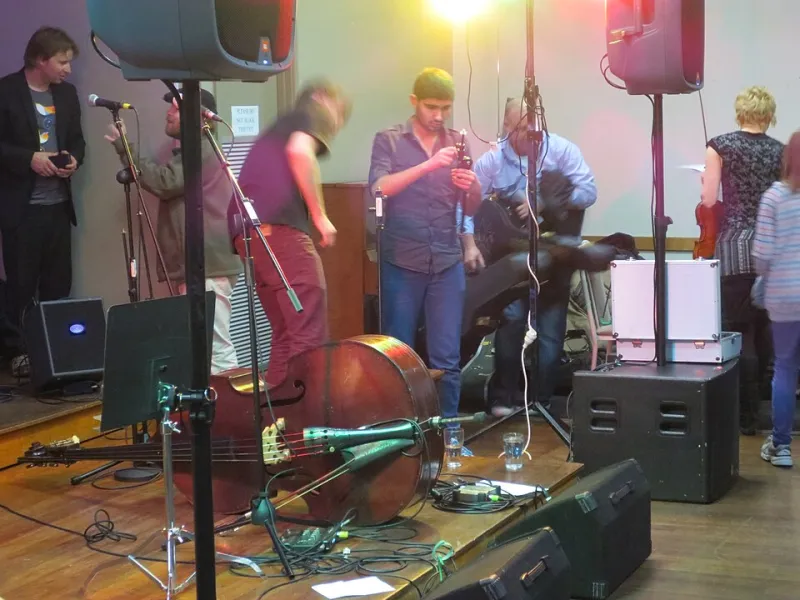
It is 5.40pm on a grey November Tuesday, and the gig is already running late. Not the band — the van. A battered Transit is idling on the edge of a Northern Quarter side street, hazard lights blinking, while a promoter peers at a bay that is half-occupied by a delivery driver and half by a skip. The first support act is due on at eight. The amp that needs to be at the front of the stage is still strapped behind a drum kit. This is the load-in lottery, and in Manchester it is played out nightly.
The Van Is the First Instrument
Before anyone touches a monitor wedge, someone has to solve a puzzle made of kerbs, bollards and timed parking restrictions. City-centre rooms often have a narrow window: unload, move the van, unload again. Fringe venues — a church hall in Chorlton, a converted unit off Oxford Road, a room in Salford with a yard the size of a snooker table — have their own codes. Some have a verbal agreement with the shop next door. Some have a loading bay that becomes a taxi rank after six. Some have a neighbour who will tolerate a drum case on the pavement for exactly as long as it takes to carry it inside, and not a minute longer.
The result is that the first ten minutes of a gig are rarely about music. They are about space. A promoter in Ancoats describes the routine as “a relay race with a risk of a ticket”. A drummer from Stockport puts it more plainly: “You learn which streets have wardens and which have cameras. You learn which corners you can block for ninety seconds without someone leaning on a horn.”
Ten Minutes on a Double Yellow
Parking enforcement is not a side issue for live music. It is part of the production. A van left on a double yellow while a bass cab is carried up a fire escape can cost more than the door take on a small weeknight show. A permit that only covers the front of a building, not the side door, can turn a simple load-in into a two-person relay across a bus gate. Traffic wardens are not villains in this story — they are doing a job — but their presence changes behaviour. Promoters plan around them. Crews text each other about them. Bands factor them into the price of playing.
The street design matters too. Narrow pavements make it harder to stack cases. Cycle lanes and pedestrianised zones remove informal drop-off points. Bus stops and taxi ranks create no-go kerbs at exactly the hour when a venue needs its back door clear. None of this appears on a gig poster, but it determines whether a five-piece band can realistically play a room with no loading bay and a 7pm soundcheck.
The Informal Code
What fills the gap between official rules and real life is an informal code. Promoters ask neighbouring businesses if they can use a shared yard for twenty minutes. Venues put a cone out, even when they are not supposed to. Crews learn that the best load-in is often the one that happens early, quietly, and with a nominated person left with the van. There is a etiquette to it: don’t block the delivery entrance, don’t leave a trail of gaffer tape on the pavement, don’t assume the next band will move your gear for you.
In 2026, that code is under pressure. More rooms are programming midweek shows. More small tours are routing through Greater Manchester. More venues are sharing the same tight kerbs. The old workaround — “we’ll just pull up outside and be quick” — is less reliable when every street has a different enforcement pattern and every neighbour knows exactly who to call.
What Promoters Want in 2026
Ask promoters and musicians what would help, and the answers are unglamorous but practical. A clear, venue-by-venue loading map for the city centre and fringe. Short-term permits that cover the actual load-in window rather than a whole day. Better signs on shared bays. A named contact for street enforcement who understands live music schedules. And more venues working with neighbours before the gig, not after a complaint.
None of that is a substitute for a good song. But it is the infrastructure that lets the good song happen. A Manchester gig is not just a stage and a crowd; it is a van, a kerb, a permit and a set of people willing to carry a flight case further than they expected. The music starts when the house lights go down. The night really starts when the van finds a space.
The Gig Starts at the Kerb
The load-in is the part of live music that nobody photographs. It is also where the city’s rules meet its creative ambition. In 2026, Manchester’s venues are still making it work through local knowledge, favours and fast feet. The question for promoters, crews and councils is whether that improvisation can be made a little less improvised — before the next van circles the block.