The After-Work Faithful: Why Manchester’s Midweek Gigs Are Winning on Attention, Not Hype
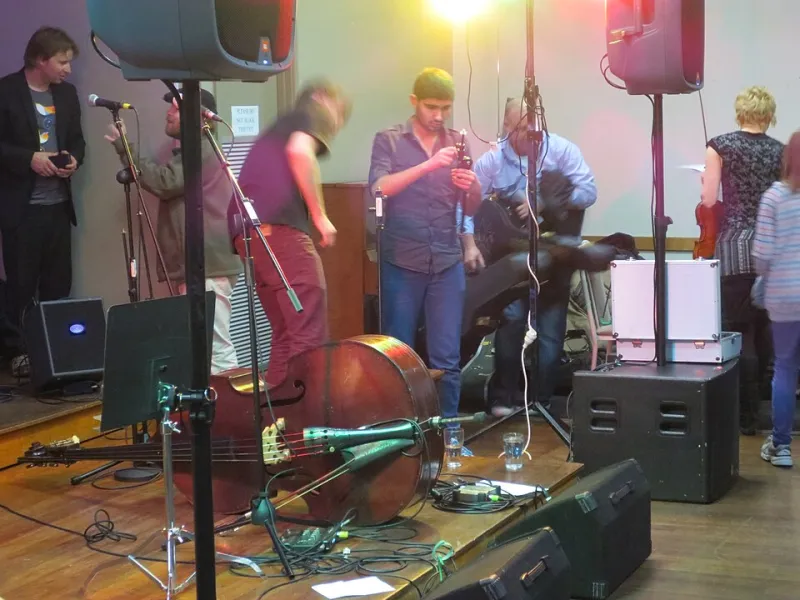
Photo: Johnscotaus, CC BY-SA 4.0, via Wikimedia Commons
There’s a particular kind of Manchester gig that doesn’t announce itself. No queue spilling down the pavement, no door tax bumped up for a Saturday, no one shouting over the support act because they’ve been on the lash since noon. It happens on a Tuesday, maybe a Wednesday, in a room off Oldham Street or down a side street in Salford. The lights go down at eight, the bar stays manageable, and the people who’ve turned up have come to listen.
For years, the weekend was the obvious answer to the question of when to put on a show. Friday and Saturday paid the bills. Midweek was for open mics, rehearsal-room scratch nights and the kind of gigs you played for other bands. In 2026, that hierarchy is starting to look less fixed. The midweek gig is no longer just a warm-up for the real thing. In plenty of Manchester rooms, it is the real thing.
The Tuesday Test
Stand in a small venue in the Northern Quarter on a Tuesday and you notice the quiet first. Not silence — there’s music, chatter at the back, the clatter of a glass being cleared — but a different kind of room tone. People are facing forward. They’re not treating the band as background to a night out. They’ve bought a ticket, they’ve got work in the morning, and they’ve made a deliberate choice to be there.
That changes the contract between artist and audience. A weekend crowd often arrives later, drinks more, talks louder and treats the headline set as the main event after hours of socialising. A midweek crowd tends to arrive on time, pay attention to the support act, and leave before the last bus turns into a pumpkin. It’s less of a night out and more of an appointment. For a certain kind of musician, that’s worth more than a fuller room on a Saturday.
The Arithmetic of a School Night
Ask promoters why they’re programming more Tuesday and Wednesday shows and the answer usually starts with money. Room hire is cheaper. Staff costs are lower. There’s less competition from club nights and big-ticket concerts. A promoter can break even on a smaller door, which means they can take a risk on a local support act, a left-field headliner or a genre that doesn’t pack out a Saturday.
“Saturday pays the rent. Tuesday pays attention,” one booker at a 120-cap room in Salford tells me. That line has stuck. The weekend still does the heavy lifting for venue income, but midweek has become the testing ground for ideas that need a listening audience rather than a party crowd.
Curfews matter too. Weekend gigs often have to finish early so the room can flip into a club night or comply with licensing. Midweek can sometimes run later, or at least without the same pressure to clear the floor by eleven. A band can play a longer set, do an encore without guilt, and still get the last tram. It’s not a universal rule — plenty of rooms have strict midweek cut-offs — but the flexibility is real.
An Audience That Listens
The after-work faithful are not a monolith. They’re nurses on a late shift, students with a nine o’clock seminar, office workers who’ve come straight from Piccadilly, and musicians off duty who want to see what everyone’s talking about. What they share is a willingness to be present. They’re not in the room because it’s the only thing open. They’re there because they chose it.
For local artists, that can be transformative. A support slot on a Saturday can feel like shouting into a social club. A support slot on a Tuesday can feel like a proper show. Artists report selling more merch midweek, not because the crowd is bigger, but because people are engaged enough to walk over to the table. They ask questions. They sign up to mailing lists. They actually remember the set the next day.
That’s a different kind of scene-building. It’s slower, quieter and less visible on social media, but it compounds. The people who come out on a Tuesday are the ones who come back on a Thursday, bring a friend, buy the EP, and turn up again when the band plays a bigger room six months later.
The Trade-Offs
None of this is free. Midweek gigs are harder to market. The walk-up trade is weaker. A promoter can’t rely on people deciding on the night. They have to build the show in advance, which means more work for less immediate reward. Venues see lower bar spend. Artists still have day jobs, and a Tuesday show can mean a grim Wednesday morning. Fees are often smaller, and the weekend buzz — the photos, the crowd noise, the sense of occasion — is harder to manufacture.
There’s also a risk of romanticising the small room. A half-full Tuesday gig is still a half-full Tuesday gig. It can be dispiriting for a band who’ve spent weeks rehearsing. The after-work faithful are loyal, but they’re not infinite. Promote too many midweek shows and you split the same audience across too many nights.
The best promoters know this. They programme midweek with intention, not desperation. They pair acts that share an audience. They keep ticket prices low. They finish on time. They treat the room as a listening space rather than a party venue. When it works, it feels less like a compromise and more like a different format entirely.
Weekend Crowd vs After-Work Faithful
So is the weekend crowd being quietly outpaced? In numbers, no. Saturday still wins. But in attention, maybe. The midweek gig has become the place where Manchester’s more adventurous programming lives — the odd-genre night, the local double-header, the band trying out new material, the support act everyone leaves talking about. The weekend is still where the big shows happen, but the midweek is where the scene argues with itself, tries things out and builds the relationships that make the bigger shows possible.
That’s not a rejection of the weekend. It’s a rebalancing. Manchester has always had a strong after-work culture — the early pint, the gig before last orders, the tram home at a reasonable hour. The midweek gig economy is simply catching up with how people actually live in 2026. Not everyone wants to lose a Saturday to a hangover. Not everyone can. The after-work faithful have made a case for the school-night show, and the rooms are starting to listen back.
For anyone booking a gig in Manchester this winter, the lesson is simple: don’t treat Tuesday as a lesser Saturday. Treat it as its own night, with its own rules, its own audience and its own rewards. The weekend will still be there. The attention is what’s worth chasing.