Crisps, Cables and a Cold Radiator: What Really Happens in Manchester's Green Rooms
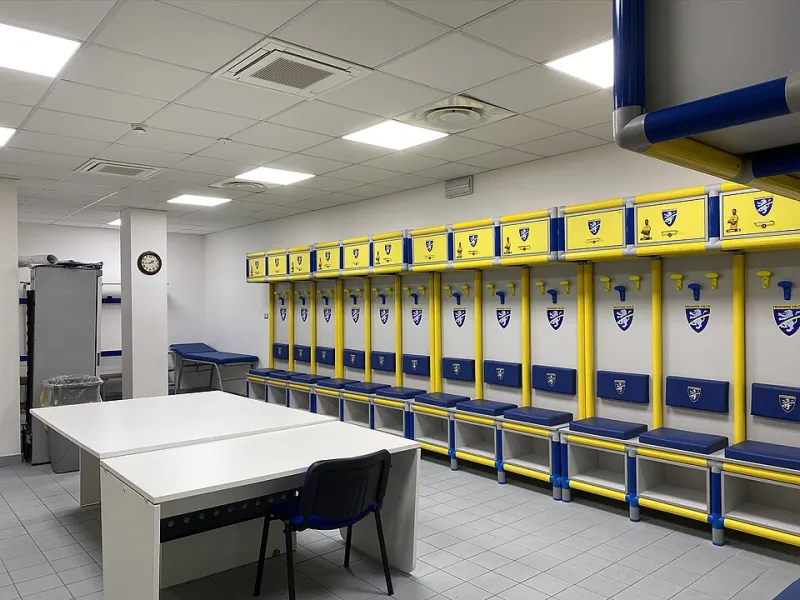
Photo: Vincenzo.togni, CC BY-SA 4.0, via Wikimedia Commons
There is a door at the back of most Manchester venues that the audience never sees, and behind it is a room that smells faintly of radiator dust, lager and someone else's deodorant. The green room is the least glamorous space in live music and possibly the most important. It is where a set is rehearsed in the head, where a rider is divided up, where a stranger becomes a bandmate for the night.
Nobody designs these rooms. They accumulate. A store cupboard in one Northern Quarter venue has been 'the dressing room' for so long that its single chair has a name. A 250-cap room in Salford has a full flat above the stage, which means headliners occasionally do their vocal warm-ups in a kitchen with the oven on.
The room behind the door
Green rooms fall into three types in this city. There is the cupboard: a mirror, a rail, a bin, one plug socket that everyone fights over. There is the office: a promoter's desk hastily cleared of paperwork, with a printed set-times sheet still blu-tacked to the wall. And there is the good one — the room with a sofa, a working fridge and a door that actually closes against the noise of the support act.
'The good green rooms are the ones with a kettle and no Wi-Fi,' says Ellie Marsh, a tour manager who has driven vans around the North West for eleven years. 'If there is a kettle, people sit down. If people sit down, they talk to each other. The best shows I have worked on started with four bands making tea in the same room.'
Rider archaeology
The rider is where a venue's character shows. On paper every rider asks for the same things: water, beer, towels, somewhere secure. What actually appears tells you everything about how a room treats the people in it.
'We do fruit, crisps, a proper pot of tea and a hot meal if the kitchen is open,' says Kofi Adjei, who manages a mid-size venue in Salford. 'It costs us maybe forty quid a night. It buys us goodwill that no amount of marketing can buy. Bands remember who fed them.'
Others remember who did not. There are venues in this city with reputations built entirely on a missing towel and a locked door, and those stories travel further and faster than any glowing review. A touring musician will forget the monitor mix within a week. They will remember, for years, being left standing in a corridor with nowhere to put a guitar case.
Nerves, rituals and the warm-up circuit
Pre-show behaviour is its own taxonomy. There is the pacer, who walks the length of the room roughly eighty times. There is the scaler, singing arpeggios into a corridor that was not built for arpeggios. There is the one who cannot be spoken to for twenty minutes and the one who will not stop talking.
The informal rule is that nobody comments on anyone else's ritual. 'You do not ask a singer if they are alright,' says Priya Nair, who promotes across three venues in the city. 'You ask if they need anything. There is a difference and everyone backstage knows it.'
The five minutes before doors is the strangest part of the night. The room is full of people who have been in a van together, arguing about parking, and now have to become a band. Most of them do it with a huddle. Some do it with a round of applause that nobody outside the door ever hears.
Crew as connective tissue
What holds the circuit together is not the artists. It is the crew — the engineers, the door staff, the bar team who know which band needs the stage cleared early. They are the ones who remember that a certain drummer needs a second DI box, or that a particular singer will ask for the air conditioning off at exactly the wrong moment.
'I have worked with the same four engineers across six venues,' Marsh says. 'That is the network. It is not a mailing list. It is people who know your name and will find you a spare snare stand at nine at night in a city where every shop is shut.'
That network is how a dep drummer gets a gig with four hours' notice. It is how a band whose van breaks on the M62 still plays. It is also, quietly, how tours get booked — a conversation by the fridge in Ancoats turns into three support slots in Leeds and Sheffield six months later.
The unwritten etiquette
Every green room runs on a code nobody has written down. The headliner's corner is respected even when the headliner is not there yet. The rider is shared, but the good stuff is offered before it is taken. Nobody eats the last thing without asking. The support act gets the mirror first because they are on first, and the headliner gets the quiet.
Break the code and it is not a row. It is a note passed to a promoter, and a name that quietly drops off a list.
Why it matters
The green room is not where the music happens. It is where the conditions for the music get made — the ten minutes of calm, the borrowed lead, the plate of something warm at half nine. For an audience, it is invisible. For anyone who has ever played a Tuesday night in a room of forty people, it is half the reason they came back the following week.