Five Minutes at a Time: How Manchester Buskers Turn Pavement Into a Stage
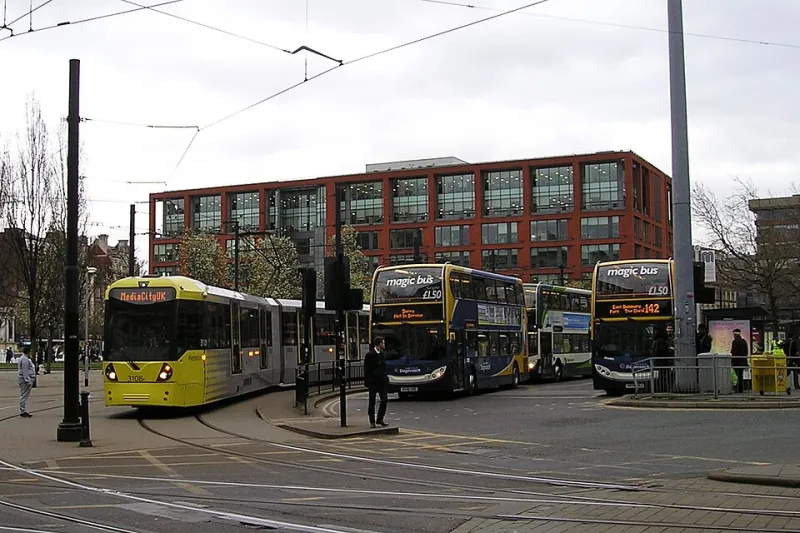
Photo: Kk70088, CC BY-SA 4.0, via Wikimedia Commons
On a wet Tuesday in November 2026, Piccadilly Gardens is doing what it always does: moving fast, smelling faintly of rain and fried food, and pretending not to watch the singer with the loop pedal. She has five minutes. Maybe less. A tram rumbles overhead, a queue forms for coffee, and somewhere between the two a familiar song gets rearranged into something slower, stranger and unmistakably local. That is the busking circuit in miniature: a live rendition economy with no box office, no guest list and no roof.
The pitch is the venue
Manchester does not have one busking scene. It has a series of rooms without walls, each with its own acoustics, traffic patterns and unwritten rules. Piccadilly Gardens is the big, blunt stage: high footfall, high noise, high competition. St Ann’s Square rewards a quieter set-up and a lunchtime crowd that actually stops. King Street and Deansgate catch the after-work drift. The Northern Quarter — Oldham Street, Thomas Street, Tib Street — suits singers and small setups who can work a doorway without blocking it. Canal Street has its own evening rhythm, and Castlefield and Ancoats have pockets where a Sunday afternoon crowd will sit still if the songs are right.
The first lesson is that a pitch is not a right. It is a temporary agreement between a performer, a pavement and the people who use it. The best buskers read that agreement in seconds: Is there room to pass? Is a shop door being blocked? Is another act already within earshot? Does the spot need a quieter volume because of nearby flats or offices? The city’s busking guidance and any pitch-specific permissions are the starting point, not the whole story. Manchester City Council’s current advice should be checked before you turn up with an amp, and private land — from shopping centres to some estate frontages — can have its own rules.
The unwritten rules
The busking code is less a rulebook than a neighbourhood treaty. Do not set up directly beside another act. Keep sets moving; a 45-to-60-minute rotation is a decent guide, especially in contested spots. Ask nearby traders if your volume is workable, and actually listen to the answer. Leave fire exits, crossings and shop doors clear. Use a small, stable tip jar and a contactless option if you have one — in 2026, a QR code for tips and mailing-list sign-ups is as standard as a guitar case. And if someone asks you to turn down, turn down. The argument you win on volume is rarely the one that gets you invited back.
There is also a performance etiquette that separates a busker from a backing track with a person attached. Name the song before you play it, or don’t — but commit either way. Acknowledge the crowd when they stop, even if it is three people and a dog. Don’t launch into a ten-minute medley when the pavement is a thoroughfare. If you are playing covers, use them as a doorway: a familiar hook earns the glance, then a well-placed original or a genuinely reworked version earns the pause.
Paperwork and practicalities
This is the less romantic part, but it is part of the craft. Check Manchester City Council’s busking guidance for the current position on permits, amplified sound and any designated pitches. Some locations may require permission from the landowner or venue; some events and street works change the map overnight. Public liability insurance is worth considering if you are using equipment or playing regularly. And keep an eye on the weather and the calendar: match days, protests, markets and tram disruptions can turn a good pitch into a bad idea in minutes.
The practical kit is simple: a lightweight amp you can carry, a backup battery, a contactless reader or QR code, a sign with your social handle, and a setlist that can flex from three songs to thirty. The best buskers also carry a story. A handwritten sign saying ‘Salford songs and borrowed ones’ does more than a laminated list of genres.
From five-minute crowd to mailing list
Ask a busker what the circuit is for and you will get two answers. The first is rent. The second is the room. Busking is the most direct audience research a local artist can do: no promoter, no ticketing data, just a pavement full of people deciding whether to stop. The artists who make it work treat each five-minute crowd as a tiny focus group. They notice which cover gets a phone out, which original gets a mid-song conversation, which joke lands and which key change makes people look up.
That is how the pavement becomes a pipeline. A QR code leads to a mailing list. A mailing list leads to a support slot. A support slot leads to a room with a door. The cover earns the glance; the original earns the follow. In a city with no shortage of stages behind closed doors, the busking circuit remains the most open one — and the one most dependent on good manners. Five minutes at a time, Manchester is still rehearsing in public.
A circuit, not a background
The next time you walk past a singer in Piccadilly Gardens or a guitarist outside a Northern Quarter bar, resist the urge to file them under atmosphere. They are part of the city’s live music infrastructure, doing the unglamorous work of turning a pavement into a stage. Buy the EP if there is one. Scan the code. Stand still for a song. And if you are the one with the guitar, leave the pitch a little better than you found it. That is the circuit.