Room Tone: How Manchester's Front-of-House Engineers Build a Gig Before Anyone Plays a Note

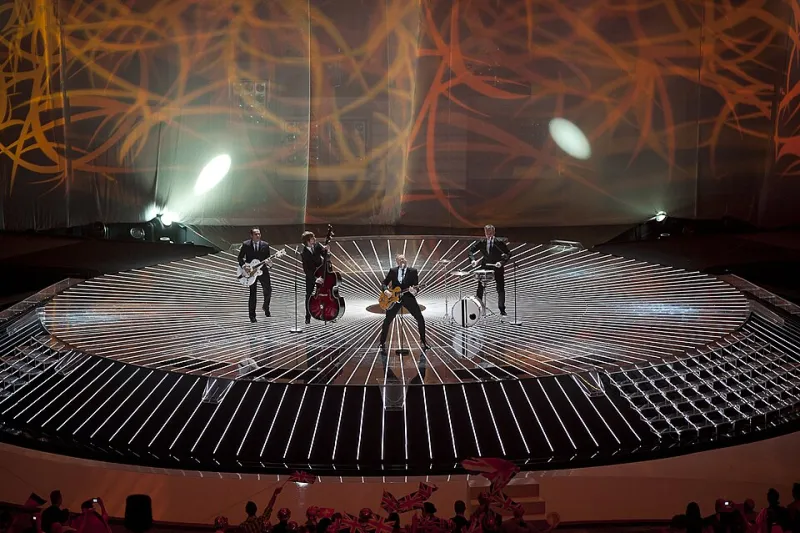
Photo: Free To Use Sounds, CC BY-SA 4.0, via Wikimedia Commons
The doors have been open twenty minutes. There's a bloke nursing a pint by the pillar, two people arguing about whether they've missed the support, and a playlist doing quiet, unglamorous work in the corner. Up at the back, behind a desk that has seen better decades, someone is pacing the room with a finger in the air like they're measuring a curtain.
This is the bit nobody buys a ticket for.
The Walk-In
'First thing I do is listen to the building with nothing in it,' says Kerry, who has run front of house at a Northern Quarter basement for the best part of six years. 'Not the PA — the building. The cellar fridges, the extractor, the boiler deciding to have a moment. If I don't know what the room sounds like empty, I can't tell what I'm fighting once there's two hundred people in it.'
That walk-in is a ritual with its own grammar. Kerry starts at the back wall, claps once, listens for the slap-back off the low ceiling, then works forward past the pillar she describes, fondly, as 'the third member of every band that plays here.' By the time the support act is loading in, she knows which two seats will eat the snare and which corner will turn a bass guitar into a woolly rumour.
Rooms With Opinions
Manchester's small rooms are not neutral. A converted textile space in Ancoats will ring for a second and a half whether you want it to or not. A proper old pub back room off Oxford Road has soft furnishings, low beams and a stage the size of a dining table, so everything above 200 people has to be built out of sheer nerve. And every engineer we spoke to had at least one horror story about a bar positioned exactly where the monitor wedge wants to be.
'You can't beat a room into submission,' says Dev, who splits his week between two mid-size venues near the universities and a Saturday slot in Salford. 'You negotiate with it. I've got a room where the vocal only sits right if I pull the mids in a way that would make a studio engineer wince. Sounds wrong on paper. Sounds correct in there.'
The Polite Art of the Line Check
Before any of that matters, there's the admin: mics on stands, DI boxes that have gone walkabout, a drummer who has brought a kit with more toms than the stage plot promised. Then the line check — the least rock and roll twenty minutes in music.
'You learn to do it fast and you learn to do it kindly,' says Anisa, a freelance engineer who works across venues in the Northern Quarter and along the Oxford Road corridor. 'A band's been in a van for three hours. They don't want a lecture. So you get a kick, a snare, a hat, a vocal, and you trust your notes from soundcheck instead of making everyone hit things repeatedly for your own comfort.'
That trust runs both ways. Plenty of touring acts now arrive with their own engineer and a laptop full of scenes. The house engineer's job shifts from mixing to translating — explaining that the room will not tolerate the sub level from the last venue, that the vocal needs the reverb pulled back, that yes, the desk is old, but it works and it's not the reason the guitars sounded thin in Leeds.
Building a Room Out of People
The other half of the job is the audience, and 2026 has given engineers a lot more of them to handle. More gigs, more midweek shows that used to be Fridays, more rooms running something five nights out of seven. A full house changes the acoustics as surely as a carpet does: bodies absorb the top end, chatter adds its own broadband hiss, and a room that sounded bright at seven can feel muffled and shouty by half nine.
'You're mixing the crowd as much as the band,' Kerry says. 'If the back of the room is talking, that's information. Sometimes it's the PA. Usually it's that the vocal isn't cutting through where people are standing.'
So the fader moves. A touch more vocal. A little less cymbal. A snare sample nudged in under the acoustic kit because the ceiling is eating the crack. None of it is on the setlist, and none of it gets acknowledged from the stage, which is exactly how the good ones like it.
The Ten Seconds
The house lights drop. The band walk on. Somebody whoops. And for roughly ten seconds, the person at the back of the room is doing the most consequential work of their night: hands on the desk, ears ahead of the audience, waiting to hear what the first note actually does once it hits the walls.
'You get one chance at a first impression,' Anisa says. 'If the vocal's wrong on the opening line, you've lost the front row for a song. So you fix it before they notice, and then you spend the rest of the night pretending you were never worried.'
By the encore, nobody in the room is thinking about the desk. That's the point. The best front-of-house work in Manchester is the work you can't hear — a quiet negotiation between a stubborn building, a tired band and a few hundred people who just want the chorus to land.