The Doorway Is the Support Act: Hand-Painted Signs and the Manchester Rooms That Wear Them
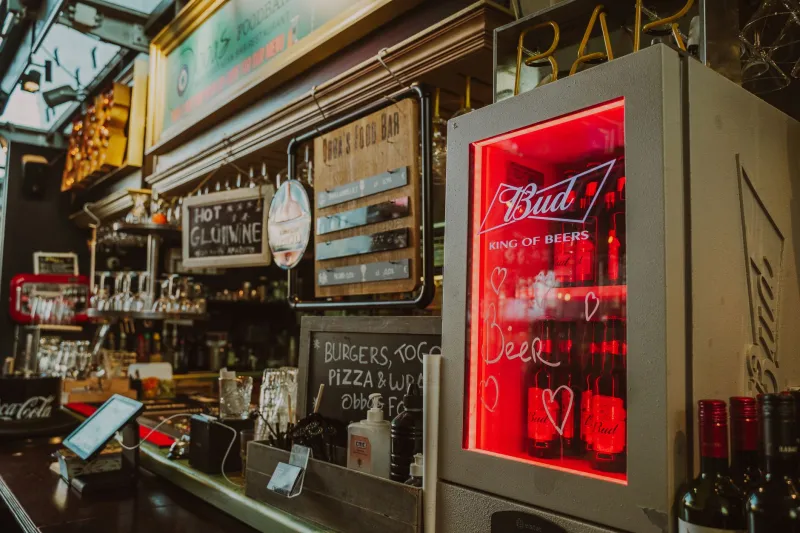
Manchester doesn’t do subtle frontages. A room might be a basement with a soundsystem held together by gaffer tape, but the doorway will still have an opinion. It might be a chalkboard propped against a drainpipe, an enamel plaque screwed into brick, or a neon squiggle above a fire exit that looks like it was drawn by someone who’d just heard a really good bassline. In 2026, when every gig is a pixel and every pixel is a post, the hand-made sign is one of the last bits of venue identity you have to physically turn up for.
That’s not nostalgia. It’s practicality with a bit of swagger. A doorway sign has to work in Manchester rain, under pub light, next to a bin, at 7pm in November. It has to tell you what kind of night you’re about to have without a trailer, a teaser or a link in bio. And the people who make them are part of the city’s creative infrastructure — even if their names rarely make the poster.
Three sign makers, three ways of saying “come in”
Mara Voss, Hatch & Hue, Northern Quarter. Mara works mainly in chalk and enamel, and she’s fussy about the boring bits: how thick the chalk is, how the board sits against a wall, whether the lettering will still read when someone’s stood in front of it vaping. Her chalkboards for small venues and cafe-bars are deliberately imperfect — a wobbly ampersand, a slightly crowded line — because a perfectly kerned board can look like it belongs to a brand rather than a room. “A chalkboard should feel like it was done this afternoon,” she says. “Because it was. That’s the point.” Her enamel work is the opposite: slow, fired, meant to outlast the lease. Both do the same job. They make a doorway feel authored.
Ellis Crompton, North Wall Lettering, Ancoats. Ellis came to sign painting through record sleeves and skate graphics, and now spends a lot of time up ladders in Ancoats, lettering glass, metal and the occasional reclaimed door. He talks about “the kerb view” — what a sign looks like from across the road, in the rain, with a bus going past. Most digital promotion is designed for a thumb; Ellis designs for a pavement. His enamel signs often include tiny details you only notice up close: a painted border, a date, a joke in the corner. “If someone’s standing outside waiting for a mate, they’ve got two minutes to look at something,” he says. “Might as well give them something worth looking at.”
Priya Nair, Salford Neon & Sign. Priya’s patch is neon and cold cathode, which means she spends as much time thinking about transformers and maintenance as she does about colour. A neon doorway is a commitment: it hums, it heats up, it occasionally needs a fix. That’s part of the appeal. In Salford, she’s worked on doorway pieces for studios, bars and small venues that want a bit of glow without looking like a chain. “Neon is honest,” she says. “You can see the tube. You can see it’s made by a person. It’s not a screen pretending to be a light.”
A walkable route through the doorways
You can see the difference a sign makes in about an hour and a half, if you don’t stop for a pint. Start in the Northern Quarter, where the chalkboard is king. Wander the side streets off Oldham Street and Thomas Street and look at the A-boards: some are beautiful, some are barely legible, and the best ones tell you exactly what’s on without a single logo. The doorway is doing the work of a flyer, a bouncer and a mate saying “it’s sound in here.”
Then head east to Ancoats. The signs get more permanent — enamel, painted glass, lettering that’s been screwed into a wall and left to weather. This is where you notice how a sign ages. A chalkboard gets wiped; enamel gets a patina. A painted doorway in Ancoats looks better after a few winters, which is not something you can say about a laminated poster.
Finish in Salford, where the neon comes out. Look for the low glow above a door, the tube bending round a corner, the little buzz you can hear if the street is quiet. It’s not about brightness. It’s about welcome. A neon doorway says someone cared enough to wire something up properly.
Why handmade still matters in a saturated city
Manchester is not short of ways to promote a gig. You can target a postcode, boost a reel, build a landing page. But none of that changes the physical fact of a doorway. A hand-painted sign is site-specific: it belongs to that wall, that street, that room. It can’t be A/B tested. It can’t be scrolled past. It either works when you’re stood in front of it or it doesn’t.
That’s why venue staff keep coming back to sign painters. A chalkboard can be changed on a Tuesday; an enamel sign can last a decade; a neon tube can become the thing people use to describe where to meet. These details shape a room’s identity before a single note is played. They’re the support act nobody bills.
And in a city that loves a bit of character, that matters. A doorway is the first rendition of the night. Best to make it a good one.