Third Song, False Ending, Last Bus: Building a Manchester Set That Fits the Room

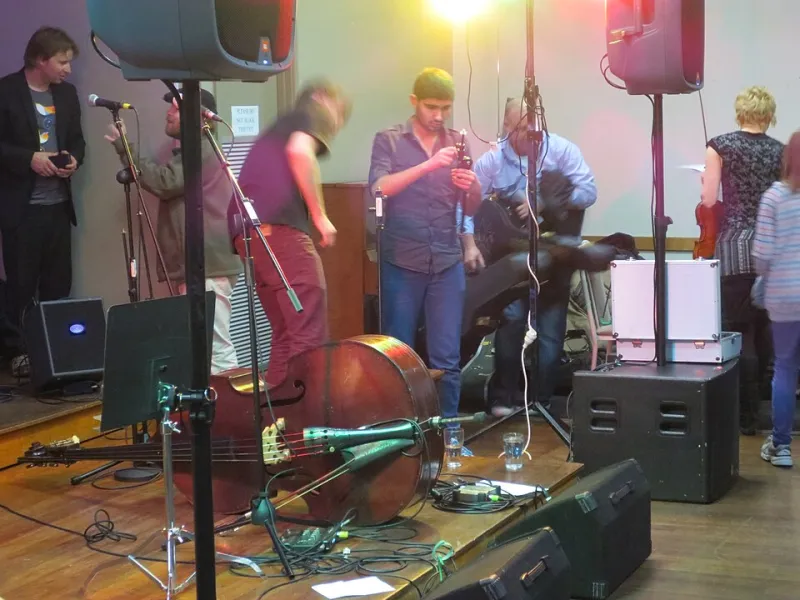
Photo: Adambean34, CC BY 4.0, via Wikimedia Commons
There is a moment, usually about twenty minutes before doors, when a Manchester setlist stops being a list of songs and becomes a plan for a room. The running order gets taped to a monitor wedge, copied onto a phone note, or scribbled on the back of a merch sheet. Then someone looks at the clock, the ceiling, the bar, the stack of amps and says the thing that really matters: not what are we playing, but what does this room need, and in what order?
That question is the difference between a playlist and a live set. A playlist is built for skip buttons; a setlist is built for people standing three feet away from a singer who has just realised the second song is too low for the room and the third song is the one everybody came for. In Manchester, where the same band might play a 200-cap room above a pub on Tuesday and a converted hall on Saturday, sequencing is not admin. It is part of the performance.
The room writes the first draft
Every venue gives a band a different set of problems. A low ceiling in a small room can swallow a quiet opening number entirely. A high, echo-heavy space can turn a fast song into a smear. A room where the bar sits at the back means the first ten minutes are soundtracked by pints being pulled and coats being unzipped, whether the band likes it or not.
So the opening song has a job that has nothing to do with streaming numbers. It has to introduce the band to a room that may not be fully listening yet. Sometimes that means starting with the most immediate thing in the set. Sometimes it means starting with a slow, strange song that makes people stop talking because they cannot work out where it is going. Both can work. The mistake is pretending the room is already onside.
Promoters and sound engineers will tell you the same thing in different ways: the first song is a soundcheck the audience can see. It tells the desk what the vocal really does, how much low end the room can take, and whether the back wall is going to bounce everything back at the stage. A band that opens with the same song in every venue is not sequencing for the room. They are sequencing for the setlist document.
The third-song problem
Ask a musician about running order and the conversation eventually reaches the third song. It is not always the obvious single. It is the song that has to carry the room from the introduction into the actual gig. By the third number, the audience has stopped deciding whether to stay and started deciding how much to give you. The third song is where a set either tightens or sags.
In a short support slot, the third song often has to do the work of a chorus, a change of pace and a small proof of personality. In a headline set, it can be the first proper left turn: the song that says this is not going to be forty-five minutes of the same tempo. If the third song is the same key, same speed and same shape as the first two, the room can settle into a polite rhythm that is hard to break later.
That is why some acts move their most loved song out of the obvious slot. Put the big one third and you get a spike, then a long climb down. Put it seventh and you get something to aim at. Neither is wrong. The point is that the song has to answer to what has already happened in the room, not to the order it appears on a record.
Pacing, key changes and the bits between songs
A live set is not just songs. It is the gaps between them. Manchester audiences are not shy about filling those gaps with chatter if the band leaves too much dead air, especially in rooms where the bar is close and the match is on someone's phone. Smart sequencing accounts for the practical stuff: tuning, capo changes, pedal swaps, a singer reaching for water, a guitarist swapping a broken string.
Sometimes the answer is to write the set so the quiet song follows the one that needs a guitar change. Sometimes it is to group the songs that need the same tuning. Sometimes it is to accept that a thirty-second pause is fine if the band does something with it — a spoken line, a false start, a joke that lands because the room is small enough to hear it.
False endings are a particular Manchester pleasure. In a big room, they can feel like a trick. In a small one, they can be a shared joke. The band stops, the crowd claps, the band starts again, and for a second everyone is in on the same thing. But a false ending has to be earned. Do it too early and the room feels managed. Do it at the wrong volume and it just looks like someone unplugged a lead. The best ones are sequenced as part of the night's temperature, not dropped in because the song has a quiet last bar.
The crowd is the running order
A midweek gig is not a weekend gig. An after-work crowd in a city-centre room is different from a Saturday crowd that has been out since lunchtime. A support slot at seven is different from a headline set at ten. The setlist has to respect the clock, not just the songs.
That might mean cutting the slow one because the room is still arriving. It might mean moving the new song earlier, while people are curious, rather than later, when they want the ones they know. It might mean ending on time because the last tram is not a metaphor and the venue has a curfew. The best Manchester acts are ruthless about this. They know that a tight forty minutes leaves a room wanting more, while a loose fifty-five minutes can leave it checking its phone.
There is also the matter of who is actually in front of you. A hometown crowd may tolerate the deep cut. A Tuesday crowd in a room full of people who came for the headliner may not. Sequencing for the audience is not selling out. It is reading the room. The bands that do it well can play the same eight songs in two different orders and make both nights feel like they were built for that specific crowd.
What the running order is really for
A setlist is a small piece of temporary architecture. It decides where the doors are, where the stairs go, how long the room holds its breath. When it works, nobody notices the joins. They just notice that the gig had a shape. When it fails, the room feels longer than it is and the bar looks more interesting than the stage.
So the next time you see a band tape a running order to the floor, look at the third song. Look at where the quiet one sits. Look at whether the last song is really the last song. The setlist is not a playlist with the gaps removed. It is a plan for the people in the room, written by people who have stood in the same spot and worked out what the night needs next.