Below the Street: Three Manchester Rooms Rewriting the Night Out
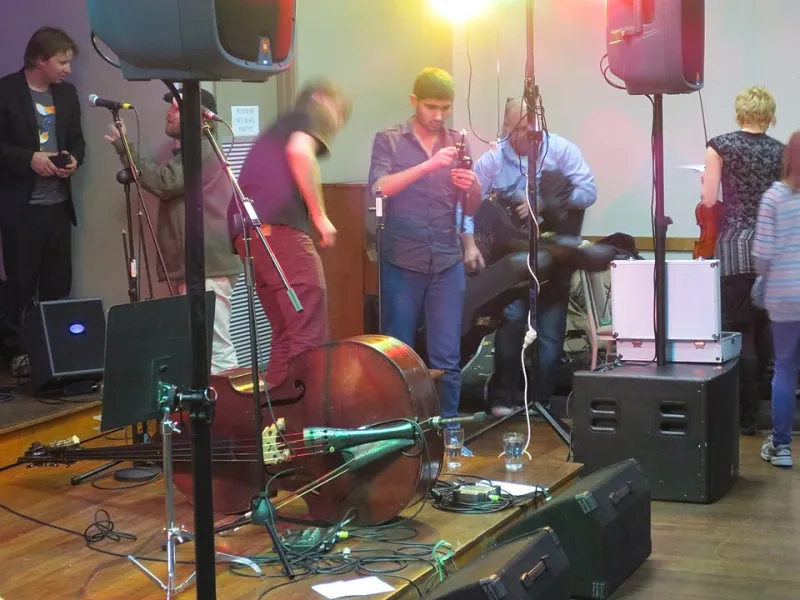
Photo: Johnscotaus, CC BY-SA 4.0, via Wikimedia Commons
Manchester has never been short of a night out. The city can fill an arena, a warehouse and a back room on the same Saturday, and still leave you queuing for a pint. But somewhere between the tribute-act circuit and the big-ticket touring shows, a smaller ecosystem has been quietly getting louder. In 2026, some of the most interesting live music in Greater Manchester is happening below street level: in a Salford railway arch, a Northern Quarter cellar and an Ancoats basement that feels like someone’s very tidy utility room.
These rooms are not trying to be clubs. They are not trying to be “immersive experiences” either. They are trying to put the right act in front of the right crowd with a sound system that does not flinch. The result is a distinctly Manchester alternative to the tribute-act treadmill — one built on strange bills, short sets and audiences who have been asked, politely but firmly, to shut up during the quiet bits.
Arch 12: the railway arch that books like a mixtape
Arch 12 sits under the railway lines in Salford, a curved brick room that shakes gently whenever a train goes over. Capacity is around 120, depending on how many people are standing near the bar. The sound system is custom, built by engineer Liam Shore, and the room has the kind of low-end thump that makes electronic music feel physical without turning everything into mush.
Mara Quinn programmes the venue. She used to book bands in Leeds, then moved across the Pennines and started putting on nights in the arch in 2019. Her rule is simple: no tribute acts, no covers, and at least one local support on every bill. “I want people to leave having seen something they could not have predicted,” she says. “That might be a noise duo from Rochdale, a rapper from Longsight and a folk singer from Stockport on the same night. If it works, it works.”
The arch’s booking policy leans towards leftfield electronic, post-punk and experimental pop, but Quinn resists the idea that it has a “genre”. What it has is a format: two or three acts, short changeovers, a DJ until 1am. Tickets are usually £8–£12, and the crowd is a mix of regulars, students and people who have come because someone told them the sound is good.
Crowd etiquette matters here. There is no phone-free policy, but there is a sign by the door asking people to keep conversations out of the main room during sets. Regular punter Aisha Khan, who has been going to Arch 12 for two years, says the atmosphere is the draw. “Nobody is trying to be seen,” she says. “You can stand near the front and actually listen. That sounds basic, but it is not.”
Harker Street Cellar: no stage, no barrier
The Harker Street Cellar is exactly what it sounds like: a low-ceilinged room beneath a Northern Quarter shop, reached by a narrow staircase that feels like you are being let into a secret. Capacity is 70 at a push. There is no stage. The band plays on the floor, and the audience stands around them in a loose semicircle.
Booker Danny Okoro took over the programming in 2023. He describes the room as “a listening room that happens to have a bar”. The sound system is a restored Turbosound rig that Okoro says was “rescued from a working men’s club in Wigan”. It is not loud in the way a club is loud; it is clear in a way that makes a whispered vocal sound like a secret.
The programming is deliberately mixed: spoken word on the first Tuesday, jazz and improvised music on Thursdays, and a monthly “open floor” night for experimental electronics and comedy. Okoro says the no-stage setup changes how acts behave. “People cannot hide behind a barrier,” he says. “They have to connect. Some acts hate it. The ones who love it are usually the ones we book again.”
Regulars talk about the cellar’s etiquette as much as the music. There is no talking during sets. Phones are allowed, but filming a whole set is frowned upon. “It is not a church,” says Okoro. “But if you are going to have a conversation, go upstairs.”
The Chute: the Ancoats basement with a door policy
The Chute is the smallest of the three, a 90-capacity basement under a former textile building in Ancoats. The room is painted black, the ceiling is low, and the air conditioning is best described as optimistic. The sound system is a compact rig tuned by booker Rosa Bell, who runs the venue with a small team of volunteers.
Bell’s door policy is the thing people talk about. It is not a strict genre policy, but it is a vibe policy: no tribute nights, no stag dos, no “ironic” fancy dress. “We want people who are here for the music,” she says. “That is not snobbery. It is just the only way a room this size works.”
The Chute programmes full-band tryouts, noise, folk and the occasional comedy night. Tickets are £5–£10, and the venue pays acts a guaranteed fee rather than a door split. Bell says that model is only possible because the rent is low and the bar is busy. “We are not trying to get rich,” she says. “We are trying to make sure the person on stage gets paid before the person behind the bar.”
Regulars describe the crowd as “polite but up for it”. There is a mosh pit when it makes sense, and a silence when it does not. “You can tell the difference between a Chute crowd and a normal Saturday night crowd,” says regular Tom Ellis. “People are not just waiting for the DJ.”
Why the basement model works
The three venues are not a movement, and none of the bookers I spoke to were keen on the idea that they are “saving” Manchester music. But they do share a set of principles: pay the acts, keep the bills short, book local support, and trust the audience to listen.
That model is not new. Manchester has a long history of small rooms doing exactly this, from the Boardwalk to the Roadhouse. But in 2026, with touring costs rising and tribute acts filling ever more calendar slots, the basement rooms feel like a corrective. They are cheaper to run, more flexible and closer to the artists who are still building a following.
“The tribute circuit is fine if that is what you want,” says Quinn. “But it cannot be the only thing. You need rooms where people can fail. That is how you get the next thing.”
For a night out, that means something simple: you can pay a tenner, stand in a low-ceilinged room, and hear something you have never heard before. In a city that sometimes feels like it is always looking backwards, that is worth protecting.